Welcome to our Trainer Profile series, where we highlight the dedicated individuals who make the iCanConnect program so impactful.
Today, we’re honored to feature Harris Rosensweig, an iCanConnect trainer in Washington, D.C. with more than 35 years of experience working with assistive technology. Harris has witnessed firsthand the transformative evolution of tools designed to enhance independence for individuals with hearing and vision loss. From the early days of text-based systems to the advent of Microsoft Windows, the iPhone, and beyond, his unwavering goal as an iCanConnect trainer has been to empower those he works with through distance communication solutions.
In this Q&A, Harris shares insights into his journey, his passion for providing premium service, and the rewarding experiences he’s had working with iCanConnect participants since 2016.
Q: What made you want to become an iCanConnect trainer?
A: One of the things that truly drives my passion is having witnessed, over decades, the insufficient services available for people with disabilities. When I first started training people how to use assistive technology, I was determined to make sure the services I provide are premium. iCanConnect is exactly that – a premium program. It offers personal assessments, distance communication equipment and technology tailored to each participant’s needs, and individual training. It’s a truly remarkable program. There’s nothing else like it.
Q: Can you describe what a typical day is like as an iCanConnect trainer?
A: A typical day for me involves assessing, training, and supporting iCanConnect participants regarding the technology or strategies that will help them achieve their distance communication goals. I’m part of an excellent, highly collaborative team that works closely together to ensure every participant, along with their family and loved ones, feels supported, understood, and guided throughout the entire process. From intake through training, we all work together to gather the right information, understand each participant’s needs, and make sure they are matched with the most appropriate trainer based on their communication goals. We take this process very seriously and are focused on making it as smooth, responsive, and personalized as possible so participants and their families feel confident, cared for, and supported every step of the way.
When doing assessments, using the information gathered through our intake process, I try to anticipate the types of equipment and technology the new program participant will likely need before an assessment. I try my best to guess which equipment samples to bring to an appointment, as I never want to arrive without background knowledge or having researched potential solutions for their distance communication needs. Being as prepared as possible is incredibly important to me. It’s the same philosophy I use when training participants, which is to have a solid understanding of the equipment, the participant’s goals, and a training plan.
I often describe myself as a ‘high tech social worker’ because I frequently need to adopt a counseling approach during my training or assessment visits. You can’t go into a meeting with a participant and act like a robot. You have to be relatable and supportive. I consider questions like: Does the participant have a support system? Are family members present for the assessment and actively involved in the participant’s life?
I view the assessment and training sessions as more of a conversation. It can be overwhelming for participants when they’re introduced to many different types of equipment, so I strive to make them comfortable. Each assessment and training session is unique and tailored to the individual. Some participants, especially younger and more tech-savvy ones, come in with a good idea of what equipment they need.
I feel a great responsibility to make the assessment and training sessions as comfortable and positive an experience as possible, and to provide them with the best equipment to meet their distance communication needs.
Q: What are some challenges you face in your work, and how do you overcome them?
A: My work presents a few challenges, primarily around the ever-evolving landscape of assistive technology and the diverse needs of our participants. I pride myself on staying knowledgeable, but with new equipment and technology constantly emerging, it can be demanding to keep up-to-date on everything and adapt my approach for a wide range of individuals. To help, I’ve compiled a comprehensive library of resource documents – I call them my cheat sheets, which help me navigate technical complexities, especially when dealing with nuances like braille displays interacting with different operating systems.
Another challenge we face is ensuring that the assistive technology is truly assistive for each participant’s unique situation. For instance, I work with a participant who had ALS-like symptoms, affecting both her hearing and vision, and is bed-bound. In cases like these, we must creatively consider how standard equipment can be adapted and securely attached (in this case, to a moving table above her bed) to meet the person’s specific needs, often requiring a highly individualized approach. Each situation pushes me to find innovative solutions to make the technology work seamlessly for the participant.
Q: What’s most rewarding about your work with iCanConnect participants? Do you have a specific success story or a memorable moment you’d like to share?
A: The most rewarding aspect of being an iCanConnect trainer is witnessing the progression of participants from feeling isolated and in need of help, to becoming more independent and thriving with the right equipment and training. I witness, in real time, broken connections being healed.
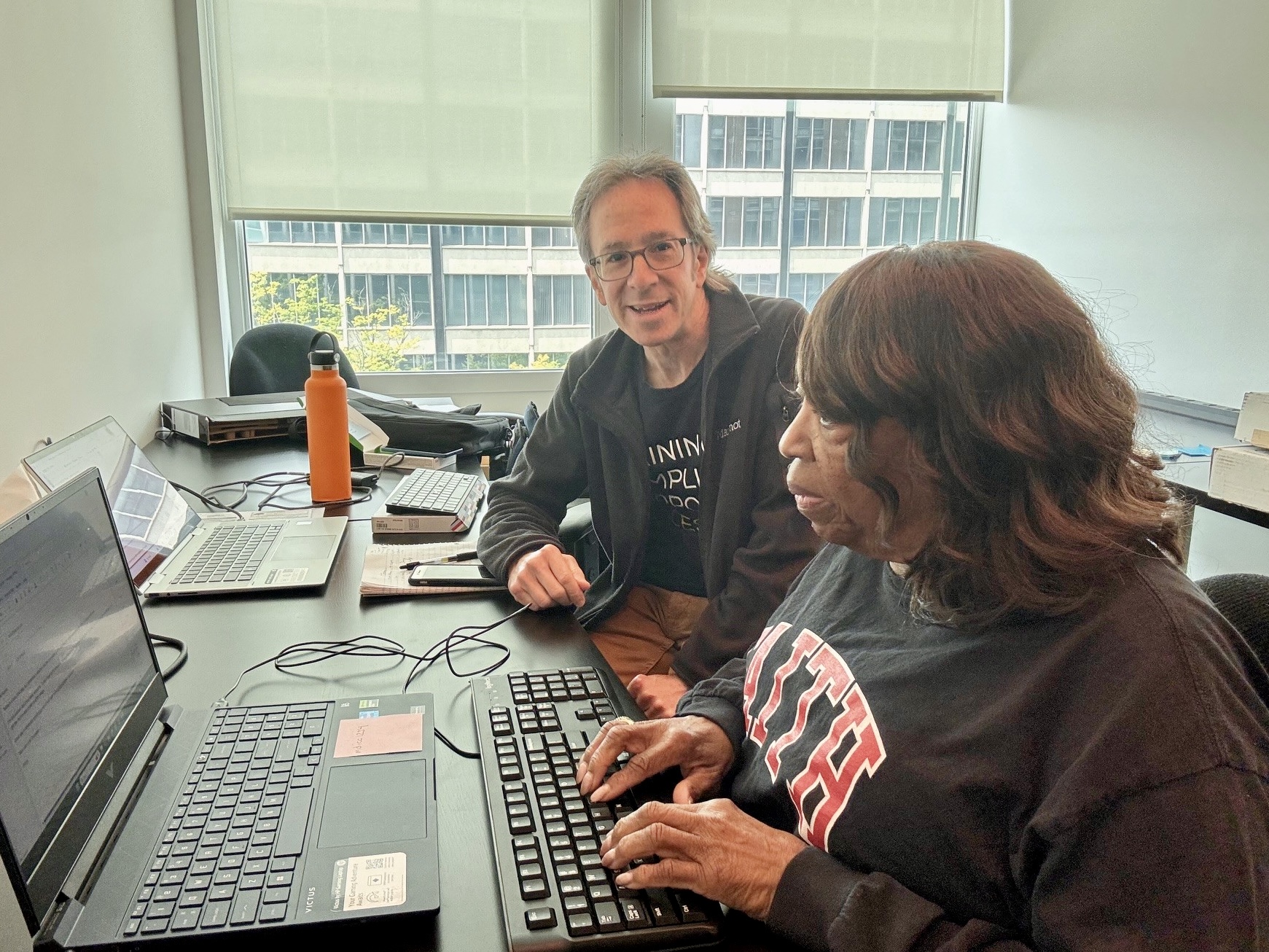
One of my most rewarding experiences was working with Armitcher “Mitch” Delaney, a retired federal worker. To compensate for her low vision while at work, she would sit very close to the screen. Once she retired, Mitch had virtually no technology and relied on an old Android flip phone she could barely operate. When we met, she was incredibly eager to learn. She was also a good typist, which is half the battle, as persons who only learned two-finger typing (meaning they require vision to type each letter) before losing their vision may not be able to use a keyboard if they have not learned to touch type.
Through iCanConnect, Mitch received a Windows laptop, JAWS screen reader and an iPhone. She was enthusiastic and like a sponge, applying herself diligently to learning how to use her new equipment.
One of the game-changers in this line of work is when there’s a strong support system from family and friends. Mitch has two wonderful daughters who are very supportive. It was a pleasure to observe her journey – supported by her family – from receiving the assistive technology she needed through iCanConnect to becoming proficient in using it. Mitch was a joy to work with, and I truly appreciated seeing her progress.
Q: Are there any particular technologies or communication methods you especially enjoy teaching?
A: I particularly enjoy teaching two main devices. The first is the BlindShell Classic. It’s a smartphone that has many of the same features as an iPhone but with the physical buttons of a cordless phone. It offers Siri-like capabilities, allows app downloads, and can even take a picture and describe what it sees. Many blind individuals appreciate its apps, or they simply use it as a basic cordless phone. While many participants have used touch-tone and cordless phones their whole lives, the BlindShell Classic provides familiarity. It can be used like a regular cordless phone, or users can use Siri to voice commands like “call John.” It also supports text messaging and runs Alexa, and its good technical support has made it a great choice for people who find the iPhone challenging. Generally, the iPhone is arguably the easiest and most accessible smartphone to use for those that can handle its complexity.
The second device I enjoy teaching is the Braille Mantis Q40. This device is truly unique, combining a keyboard with a braille display. It’s especially popular among participants who are proficient typists and good braille readers.
Q: Is there anything else you’d like to share about the iCanConnect program, its impact, or your experiences that you think would be valuable for potential participants to know?
A: To the extent possible, I strongly encourage potential participants to involve their loved ones in their journey with the iCanConnect program. Their support can make a significant difference.
About iCanConnect
iCanConnect is a national program with local contacts that provides qualified individuals with significant combined hearing and vision loss the equipment and training they need to stay connected with their family, friends, community, and the world. Learn more at www.iCanConnect.org.